
In Japan the idea of the “hero” is rooted in the idea of self sacrifice.
Although the popularity of a heroism isn’t an exclusively Japanese idea. In the American adaptations of Godzilla, for example Godzilla (1998), the climax of the movie sees the military taking the final victory. The Japanese idea of heroism however is more focused on the hero as an individual rather than a larger body. The idea of heroism is the foundation to Honda’s story of Godzilla. Like any villainous character, Godzilla is written in juxtaposition to this Japanese concept of a “hero”.
The idea heroism uniquely translated into postwar Japan. The end of the war came after the bombing of Nagasaki and Hiroshima, the American occupation, and the disillusionment with the empire. Some people viewed American occupation and MacArthur’s presence as a necessary change for Japan after the shortcomings of the Japanese monarchy. However, there was similar resentment for American occupation as a stifling reminder of the lost war.

The narrative for the future of Japan had become uncertain, as it was established into a republic and eventually given the right to govern itself apart from the United States to preserve a national identity. Honda’s Godzilla came during a period of national development and was settled into the context of national discourse. The American occupation of Japan ended officially in 1952 and organizations like the Civil Censorship Detachment were dissolved too.
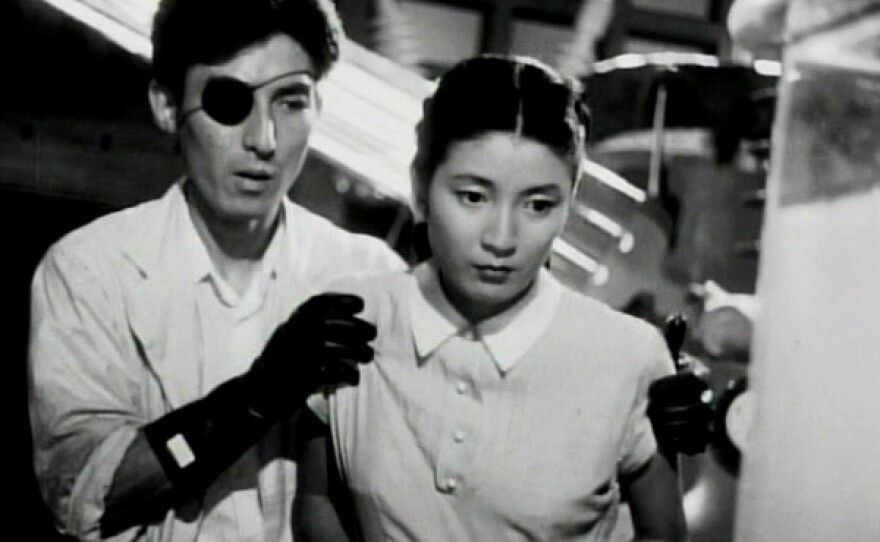
This new era gave the Japanese a new space to form a public narrative away from strict American censorship laws. The role of the hero and villain became the new focus of media produced in the fifties. War films gained popularity after censorship was lifted and provided an outlet for understanding and interpreting the war. The role of the hero created an outlet for national pride separate from a governing body. The hero was deeply personal character that stood against the status quo in defense of a moral idea. This “hero” figure in Godzilla was Serizawa, a doctor who became the savior of the story independent of any outside military or political aid.
This role that Serizawa played was the antithesis of a larger body. He operated out of a personal moral obligation and sacrificed himself for the greater good. The Japanese idea of self-sacrifice had traditionally been viewed as an action of self-autonomy and a small sense of autonomy as it was a final action committed by a single person for a greater purpose.
Honor and responsibility correspond with this idea of self-sacrifice. In Japanese tradition self sacrifice can be the honorable and righteous action to take, as it is portrayed in Godzilla 1954. Although to American audiences the actions may not have the same gravity, in an era soon after World War Two the action held a significant weight.
The action of self-sacrifice was not one out of a desire for self redemption but rather our of duty and obligation to correct and respond to the past actions he had made. The action although done by himself was one done with the intention of serving others, similar to the end goals of how many heroic American tales conclude.
References
- Purdy, Roger W. 1995. Sensō: The Japanese Remember the Pacific War. Edited by Frank Gibney. Translated by Beth Cary, N.Y., Armonk: East Gate.
- Lucken, Michael, 2017, The Japanese and the War, Translated by Karen Grimwade, Columbia University Press.
- Roberts, Michael, and Arthur Saniotis. “Introduction: Empowering the Body and ‘Noble Death.’” Social Analysis: The International Journal of Social and Cultural Practice 50, no. 1 (2006): 7–24. http://www.jstor.org/stable/23181940.
- Image Credit: https://en.wikipedia.org/wiki/Douglas_MacArthur#/media/File:MacArthur_Manila_(cropped2).jpg
.jpg)
Leave a Reply